Skip to content

Old Money Aesthetic and Hair — Why the Understated Bow Is Everywhere Right Now

The old money aesthetic has been the dominant fashion conversation for the better part of two years now, and most of the coverage has focused on clothing: the navy blazers, the crisp shirts, the loafers worn without socks. Hair gets mentioned almost as an afterthought, usually in the form of "sleek low ponytail" — as if that’s the full story.

It isn’t. And the particular accessory that’s emerged as the most quietly consistent element of this aesthetic is the ribbon bow.

Not the big, maximalist bow. Not the coquette bow in satin pink. The understated one — grosgrain in ivory or black, tied at the nape, nothing excessive about it. The bow that your grandmother’s generation wore as a matter of course, and that is now being rediscovered by people who’ve grown tired of minimalism for its own sake.

Here’s why it works, and what to actually do with it.


What "Old Money" Is Actually Responding To

Before getting into the hair specifically, it’s worth understanding what the aesthetic is reacting to, because that shapes everything about how you approach it.

Old money — or quiet luxury, or whatever you want to call the broader sensibility — is partly a rejection of the visible logo. Of the idea that clothing and accessories should broadcast their cost or their brand. It values quality that reads through texture and cut rather than labeling, restraint as a form of confidence, and the general principle that things which are genuinely good don’t need to announce themselves.

Applied to hair, that means: no accessories that require explanation, no pieces that are trying too hard to be noticed, and a general preference for things that look considered rather than decorative.

The ribbon bow fits that framework perfectly. It’s old, it’s simple, it’s recognizable without being flashy. It also, crucially, requires some actual effort to wear well — which is its own quiet signal.


Why the Bow Specifically

Hair accessories in the old money aesthetic tend to be one of three things: a simple clip (tortoiseshell or plain gold), a fabric-covered elastic, or a bow. The bow is the most interesting of these because it walks the finest line between ornamental and practical.

A tortoiseshell clip reads as purely functional. A bow reads as a choice — but a particular kind of choice, one that references a specific history of careful dressing. There’s a reason you see versions of this accessory in photographs from the 1950s, 1960s, and 1970s — it was the default for a generation of women who wore their hair with a sense of quiet formality. The current iteration is that same impulse translated into a contemporary moment that has largely forgotten it.

What makes it work within the old money aesthetic specifically:

It’s fabric, not metal or plastic. The tactile quality of a ribbon bow — its softness, the way it moves — is in tune with the overall material sensibility of the aesthetic (cashmere, linen, real leather).

It’s understated by nature. A well-tied grosgrain bow at the nape of a low ponytail is the kind of accessory you notice without being able to say exactly why. That’s the old money register.

It suggests familiarity with older codes. There’s a literacy required to wear a bow in this way — you have to know that it doesn’t read as childish in this context, which requires some understanding of how it’s been worn historically. That knowledge itself is a signal.


The Specific Versions That Work

Not all bows are old money. Here’s what the aesthetic calls for:

Grosgrain in neutrals. Black, ivory, navy, dark green. Grosgrain has a matte texture and slight ribbing that looks inherently more serious than satin. It’s the fabric equivalent of good wool — no flash, but unmistakably quality.

Measured size. The loops should be present but not dramatic. A 3–4 inch bow is about right for most contexts. Bigger reads as a statement; the goal is understated.

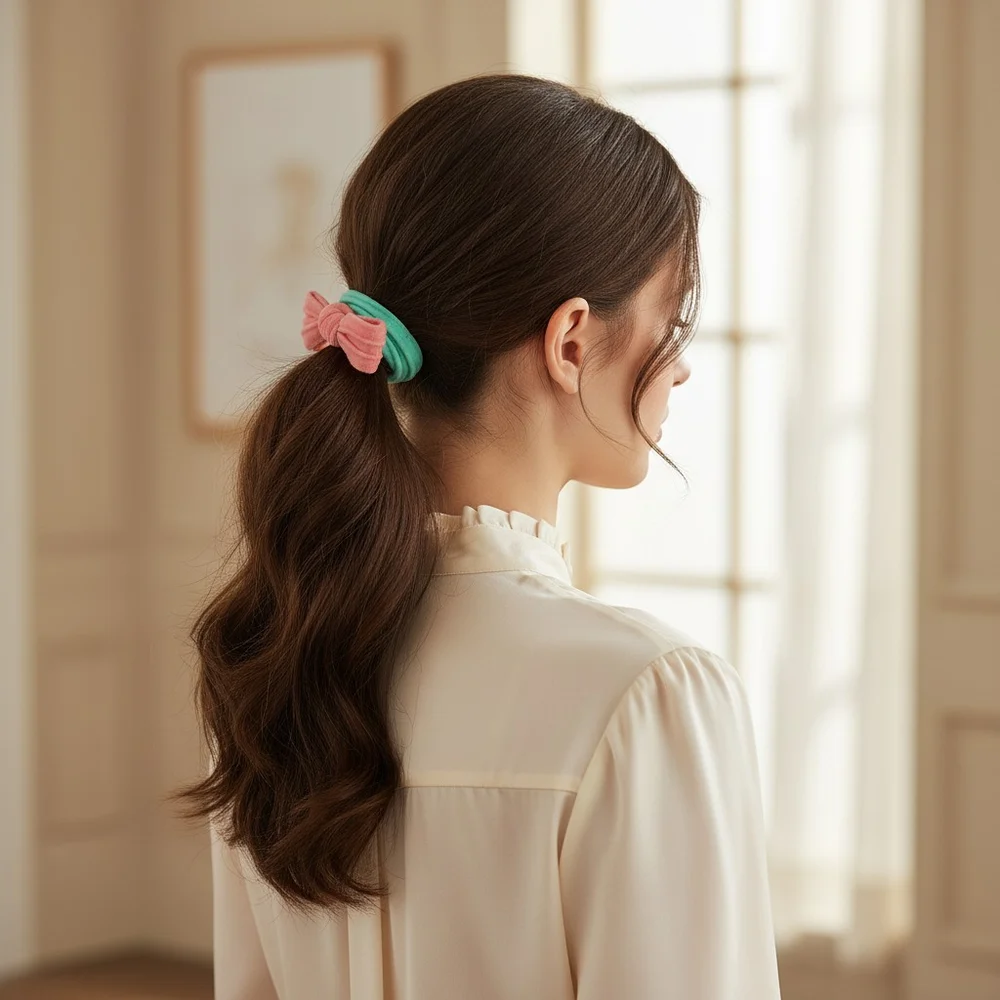
Low placement. The nape or mid-head on a half-up look. High ponytails are not the aesthetic — they’re too animated for this particular register.

Clean tying. A bow with clean, slightly taut loops and moderate-length ends. Not too loose (reads careless), not too tight (reads overwrought). The loops should be roughly equal and the ends should hang rather than splay.

One bow, nothing else. This is important. Old money accessorizing is additive only up to a point. One well-chosen bow, no other hair accessories. The bow is the look.


How to Build the Full Look

If you’re putting together a hair look within this aesthetic, the bow is usually the last decision, not the first. You build toward it.

Start with the hair itself: smooth, either naturally straight or set neatly if your hair is wavy. Low ponytail or half-up are the two most versatile options. Bun for evenings or more formal contexts.

Then the bow: grosgrain, neutral, sized proportionally. Tied carefully.

The clothing does the rest of the work. A well-cut white shirt or a good knit already communicates the aesthetic; the bow is confirmation, not explanation.


The Longevity Argument

What makes this worth paying attention to beyond the current trend cycle is that the fundamental impulse behind it isn’t going anywhere. Minimalism — the strand of fashion design that dominated the 2010s — always contained within it a certain coldness, a refusal of warmth and detail. The old money aesthetic, and the bow as a part of it, represents an answer to that: you can have restraint and warmth at the same time. You can choose carefully and still be interested in beauty for its own sake.

The ribbon bow, at its best, is exactly that combination. Simple enough to be credible, considered enough to be interesting.

[Explore the bows that work for this aesthetic →]

Shop The Look

The Cottagecore Hair Accessories Guide — What to Wear and How to Wear It

There’s something quietly rebellious about reaching for a ribbon bow instead of your phone. About slowing down enough to actually tie something in your hair. Cottagecore, at its heart, has always been less about aesthetics and more about that impulse — the one that says maybe today I don’t want to move fast.

Which is probably why it hasn’t gone anywhere.

What started as a pandemic-era mood board has settled into something much more lasting: a genuine design sensibility that values handmade things, natural materials, and the particular pleasure of an outfit that looks like it belongs in a meadow. And hair accessories are where that sensibility shows up most clearly, because they’re the easiest thing to change — and the thing people notice first.

Here’s what’s actually working right now, and how to wear it without looking like you’ve wandered off a film set.


The Ribbon Bow: Still the Centerpiece

If you’ve been paying any attention to hair trends over the past two years, you already know the ribbon bow is back. What’s interesting is how the cottagecore version differs from the coquette bow that dominated TikTok — it’s softer, more relaxed, and generally tied rather than clipped.

The key here is fabric. Satin reads as sleek and a little intentional. Grosgrain is textured and casual. For a true cottagecore look, you want something in between — a soft woven ribbon, a chiffon, or a matte silk that moves when you do. The bow shouldn’t look too perfect. A slight asymmetry is actually the point.

For hair types: if you have thicker hair, a wider ribbon (around 2–3 inches) gives you the volume to make the bow feel proportional. Fine hair works beautifully with narrower silk ribbons, half-tied at the nape for a low, delicate effect.

Wear it: at the end of a loose braid, wrapped around a low ponytail, or half-tied into a bun you’ve deliberately let fall a little loose.


Floral and Garden-Inspired Clips

Small florals — pressed flowers, hand-stitched motifs, or fabric blooms — have become the secondary element in the cottagecore hair toolkit. They work best when they feel genuinely handmade rather than mass-produced, which is a distinction you can usually see within about two seconds.

The difference between a clip that reads as intentional and one that reads as costume-y is mostly about scale and restraint. One or two small clips placed near a braid or behind an ear is an outfit detail. Six of them in a row is a flower crown you didn’t commit to.

Consider: a single fabric floral pinned just behind the ear with your hair down. Or two small clips used to pin back the front sections of a half-up look. These work for almost every hair length and are genuinely low-effort to put on.


The Hair Scarf: The Underrated Option

Neck scarves get all the press, but a silk scarf worn in the hair is arguably more versatile. Fold it into a narrow strip, wrap it around a low bun, and tie loosely at the front. That’s it. The effect is immediately somewhere between 1940s countryside and very considered Pinterest board.

What you’re looking for: lightweight fabrics that won’t bulk. A scarf around 24–30 inches works for most styles. Florals and soft ditsy prints are the obvious choice for cottagecore, but a solid sage or dusty rose in silk is just as effective and a little more wearable day-to-day.


Texture and Layers: How to Build a Look

The mistake most people make with cottagecore hair accessories is treating them like individual statements rather than components of a layered look. The aesthetic is built on accumulation — not maximalism, but the sense that small details have been chosen and combined with some thought.

A working formula: one main piece (bow or scarf) + one supporting piece (a small clip or simple pin). That’s genuinely all you need. The main piece should be visible from across the room; the supporting piece is something someone notices when they’re close.

For long hair: a loose braid tied with a wide ribbon at the bottom, with a small floral clip pinned near the crown to hold back any flyaways.

For medium hair: half-up half-down with the bow tied where the sections meet. Keep the ends of the ribbon long enough to fall down the back.

For short hair: cottagecore is actually very friendly to short cuts. A small bow at the side, tied around a few pinned-back sections, adds the same softness without fighting your hair’s natural shape.


What to Look for When You’re Shopping

This is where the aesthetic meets practical reality. A lot of what appears in trend edits under "cottagecore hair accessories" is mass-produced in materials that don’t last — acrylic satin that pills after a few wears, ribbons that slip out constantly because they haven’t been properly weighted.

The things that actually hold up:

Fabric weight. A bow made from a properly weighted ribbon holds its shape and stays in your hair. Cheap ribbon is slippery and goes flat quickly.

Hardware. For clips and pins, brass or matte gold hardware ages well and doesn’t snag. Plated finishes tend to chip.

Construction. If the bow is pre-tied rather than cut from a length of ribbon, look at the knot closely. A hand-tied bow has slight irregularities — that’s what gives it the relaxed quality the aesthetic depends on. A machine-tied bow is too symmetrical and reads stiff.

At Berkam, we make our bows in small batches using French silk and ethically sourced ribbons — specifically because the difference in how they feel and behave in the hair is noticeable from the first time you wear them. [Browse the bow collection →]


Seasonal Notes for Spring

Right now, April specifically, is probably the best moment of the year for this kind of dressing. The light is different — softer and longer — and there’s a genuine seasonal reason to reach for florals and natural fabrics rather than forcing it.

This spring, the palette that’s working hardest in cottagecore hair is what you might call "faded garden": dusty rose, warm ivory, sage, and the kind of pale yellow that’s almost cream. These sit beautifully against both light and dark hair and don’t compete with whatever you’re wearing.

For the warmer months coming up, lighter fabrics like chiffon and organza are going to be particularly relevant — they move, they’re comfortable in heat, and they have that quality of being slightly undone that the whole aesthetic depends on.


The Broader Point

There’s a reason the cottagecore aesthetic has proven more lasting than most trend cycles: it’s asking a real question, not just presenting a look. It asks what it means to choose things that are made carefully. To dress in a way that slows you down slightly, rather than speeding you up.

Hair accessories are a small but unusually personal part of that. They’re close to your face. You put them on deliberately, or you don’t. They’re one of the few wearable things that still requires some actual thought — a ribbon bow isn’t something you grab without noticing.

Which, in the context of the cottagecore sensibility, seems exactly right.


Looking for the right bow to start with? [See what’s new in the Berkam collection →]


Shop The Look