Skip to content

French Silk vs Satin vs Grosgrain — An Honest Guide to Hair Bow Fabrics

When you’re shopping for a hair bow and you see "satin ribbon bow" listed at $8, and a "French silk bow" listed at $38, it’s reasonable to wonder whether the difference is the fabric or just the story around the fabric.

It’s mostly the fabric. Here’s what’s actually different between the three materials you’ll encounter most, what each does well, and how to match the fabric to how you actually wear your hair.


Satin: The Most Common, the Most Misunderstood

Satin is a weave structure, not a raw material — a point that gets glossed over in almost every product description. "Satin" describes how the threads are arranged to produce a smooth, high-sheen surface, and it can be made from polyester, nylon, silk, or various blends. The satin you find in most mass-market hair accessories is polyester satin, and it behaves very differently from silk satin.

Polyester satin has a pronounced shine that can look plastic in certain lights. It’s quite lightweight, which means it’s easy to handle and photograph well, but it also means the bow doesn’t have much body — it tends to flatten over time and slips against the hair more than heavier fabrics. The edges, unless heat-sealed very carefully, fray quickly.

The upside: it’s inexpensive, widely available in a huge range of colors, and works well for short-term wear or occasional use.

Silk satin is a different experience entirely. The sheen is still there but it’s softer, warmer, and changes depending on the angle of the light. The fabric has genuine weight and drape. It holds a bow shape more naturally, doesn’t slip, and the edges can be finished in ways that last for years. It also has that particular quality of silk: it’s warm against the skin and doesn’t cause the small frictions that synthetic fabrics do.

If a bow is labeled "satin" without specifying the content, assume polyester. Silk satin will almost always be specified — it’s a selling point.


Grosgrain: The Workhorse

Grosgrain is a ribbed, matte ribbon with a firm, substantial feel. The defining quality is its texture: the visible horizontal ribs give it grip, which means grosgrain stays tied and holds a bow shape better than almost any other fabric. If you’ve ever had a bow work loose over the course of a day, it was probably not grosgrain.

It’s not the most glamorous option — grosgrain is workmanlike in the best sense — but it has qualities that suit a lot of everyday wearing. It looks good in neutrals. It photographs cleanly. It ages well without becoming shiny or pilling. And because it has real structure, grosgrain bows tend to stay readable (meaning: they don’t droop or collapse) even after hours of wear.

High-quality grosgrain ribbon is heavier and has finer, denser ribs. Cheap grosgrain is lighter with more widely spaced ribs and a slightly plasticky finish. The difference is visible when you hold a ribbon to the light.

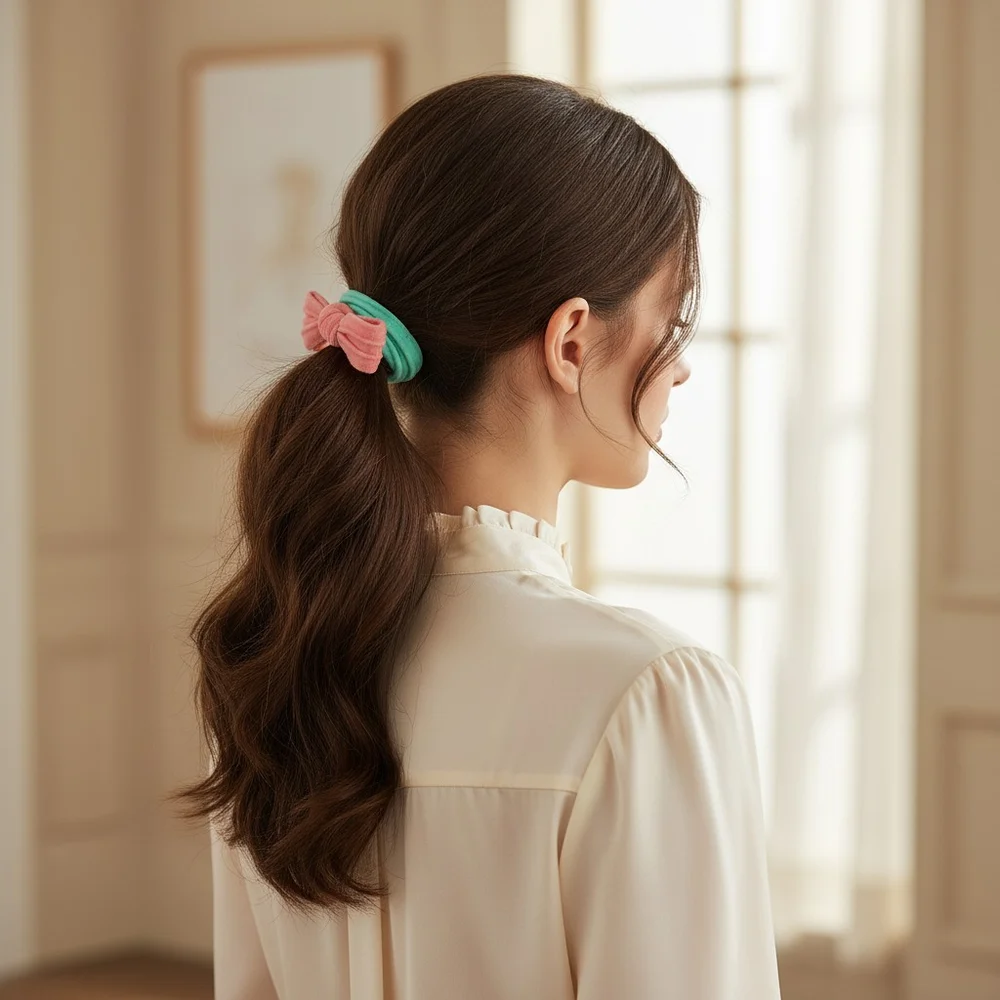
Best for: Everyday wear, office settings, any style that benefits from a bow that holds its shape reliably. The neutral-toned grosgrain bow on a low ponytail is the most wearable iteration of this accessory category.


French Silk: The Best-Behaved Option

"French silk" isn’t a technical classification so much as a description of origin and quality level. It refers to woven silk fabric sourced from the established silk mills in France and the Lyon region specifically, which has a several-hundred-year history of producing some of the best woven silks in the world.

What makes it different from generic silk ribbon: the weave is typically finer and the threads higher-quality, which produces a fabric that has weight without being stiff, sheen without being plasticky, and a quality of movement that’s hard to describe but immediately noticeable. When you tie a bow from French silk ribbon, it drapes. The loops settle naturally into something that looks considered even if you tied it in ten seconds.

It’s also more durable than you’d expect from something so light. The weave density means it doesn’t snag easily, and the edges — when properly finished — hold up to regular use.

The cost is real: French silk ribbon is significantly more expensive per meter than polyester satin or even generic silk ribbon. Which is why you’ll find it primarily in smaller-production accessories, where the economics allow for better materials at the per-unit level.

Best for: Occasion wear, weddings, any context where the bow is clearly the focal point of the look. Also particularly good for fine hair — the weight and drape mean the bow sits correctly without your hair having to support a stiff ribbon structure.


A Quick Comparison

Satin (poly) Grosgrain French silk
Texture High sheen, smooth Matte, ribbed Soft sheen, draped
Body Light Medium–firm Medium, fluid
Grip Low (slips) High (holds) Medium
Durability Low–medium High High
Best setting Casual, occasional Everyday, office Occasion, fine hair
Maintenance Low Low Gentle hand wash

How to Choose

There isn’t a universally correct answer — it depends on what you’re making the bow do.

For something you’ll wear most days: Grosgrain. It’s forgiving, it stays put, and a good grosgrain bow in a neutral color goes with most things.

For a special occasion: French silk, if the budget allows. The drape and the way it photographs are genuinely different from alternatives.

For color and variety on a lower budget: Polyester satin is a reasonable choice if you’re experimenting with colors or styles before committing to better materials. Just be aware of its limitations.

For fine or slippery hair: French silk or grosgrain over satin. The texture of both fabrics means they hold better than smooth satin, which can slide out of place throughout the day.

At Berkam, we work primarily with French silk and woven grosgrain — these are the two fabrics that justify the care we put into the construction. Polyester satin is widely available elsewhere; we’re not trying to compete on that.

[Browse our current collection →]

Shop The Look

What Actually Makes a Hair Bow “Handmade”? (And Why It Matters)

The word "handmade" is on a lot of tags right now. Etsy listings, Instagram captions, small brand websites — it’s become a default descriptor, which has made it almost meaningless. You can buy a "handmade" hair bow from a dropshipping store and a "handmade" hair bow from someone who spent forty minutes on that specific piece. Both use the same word.

So what does it actually mean? And does the distinction matter in any practical way — in how the bow looks, how it behaves in your hair, how long it lasts?

The short answer: yes, quite a lot. Here’s what to look for.


What "Handmade" Actually Covers

When a bow is genuinely handmade, the production process involves human hands at every meaningful stage: cutting the ribbon, tying or folding the bow, securing the center knot, and attaching the hardware. There’s no mold involved, no automated folding mechanism, no machine that presses a pre-cut ribbon into a standard shape.

This matters for a few concrete reasons.

First, the bow is tied rather than formed. A hand-tied bow has slight natural variation — the tension isn’t perfectly even, the loops aren’t identical. That slight imperfection is actually what gives a bow its relaxed, organic quality. A machine-formed bow is too symmetrical. It reads as flat, slightly plastic in appearance even when the material is good.

Second, the cut edges are often finished by hand — either heat-sealed or hand-fray-sealed. This is the difference between a ribbon that frays after three wears and one that holds its edge for years.

Third, the attachment point — where the bow meets the clip or barrette — is usually secured more carefully, because a person is checking the tension and finish as they go. Machine-made bows often have attachment points that are technically secure but feel flimsy if you tug them with any purpose.


The Materials Question

Genuine handmade production almost always involves better materials, not because the maker is morally superior but because the economics work differently. When you’re producing at scale, you buy materials at volume and accept tradeoffs. When you’re making in small batches, you buy less of something better, because your margin per piece is higher and your reputation depends on the quality of each individual item.

In practice, this means the difference between:

Ribbon quality. Factory-grade satin ribbon has a slight plasticky sheen and is often quite lightweight — it looks good in a photograph but lies flat in the hair rather than draping. A properly woven grosgrain or a real woven silk has actual body, which means the bow holds its shape and moves naturally rather than flopping.

Hardware. Stamped brass barrettes and clips age well and don’t snag. Thin-plated findings look fine initially but the plating wears through — often within a few months — and the exposed metal can tangle in fine hair.

Linings and inner construction. A well-made bow that you’d wear to, say, a wedding, has a small inner support — either a piece of the same ribbon or a small strip of stiffened fabric — that keeps the loops from collapsing. Cheaper construction skips this and the bow gradually wilts.


How to Tell the Difference When Shopping

You can’t always handle something before you buy it, especially online. But there are reliable ways to read a product listing.

Look at the photos carefully. A genuinely handmade bow photographed at close range will show the texture of the ribbon — the weave, the slight variation in the knot, the way the fabric catches light at different angles. Heavily edited product photos that flatten texture are a bad sign.

Read the description for specifics. Vague descriptions ("beautiful handmade bow!") tell you nothing. Meaningful descriptions give you information: the ribbon width, the fabric type, the barrette width, how the bow is finished. If the maker can’t or won’t describe the construction, that’s worth noting.

Look at the scale of the operation. If someone is selling 200 units a week of the same bow in 30 colorways, at least some of that production is automated or outsourced. That’s not necessarily bad — but it isn’t handmade in the full sense of the word. Small-batch makers typically sell limited quantities, often note when things are out of stock, and have longer production times for custom orders.

Price is a rough indicator, not a reliable one. Truly handmade items take time. If a bow is priced at the same level as a fast-fashion accessory, the economics don’t add up for genuine hand production. That said, price alone doesn’t guarantee quality — some brands charge premium prices for very average construction.


What We Do Differently at Berkam

At Berkam, every bow is hand-assembled in small batches. That means we cut our ribbons to length, tie each bow individually, finish the edges by hand, and attach the hardware with enough care that we’d notice if something was off.

The ribbons we use are sourced from European suppliers — French silk and woven grosgrain that have actual weight and structure. The hardware is brass. We don’t pre-tie and stockpile hundreds of bows waiting for orders; we make what we know we can sell, which keeps the quality consistent across every piece.

We started doing it this way because our founder spent years collecting antique hair accessories — the kind of pieces that are sixty, seventy years old and still hold their shape. That kind of longevity comes from genuine material and genuine construction. There’s no shortcut that replicates it.

[See the bows we’re making right now →]


Does Any of This Actually Matter?

If you’re buying a bow to wear once or twice, probably not. Mass-produced accessories serve that purpose fine.

But if you’re building a collection of things you actually reach for — the pieces you wear because they feel right, and that still look good two years from now — then the distinction is real. A handmade bow, made from proper ribbon and finished carefully, is going to outlast several of its factory-made equivalents. It’s going to hold its shape. And it’s going to look like something chosen rather than just added.

That’s what "handmade" is supposed to mean. When it does, it’s worth the difference.


Want to see what careful construction actually looks like? [Browse the Berkam collection →]


Shop The Look